

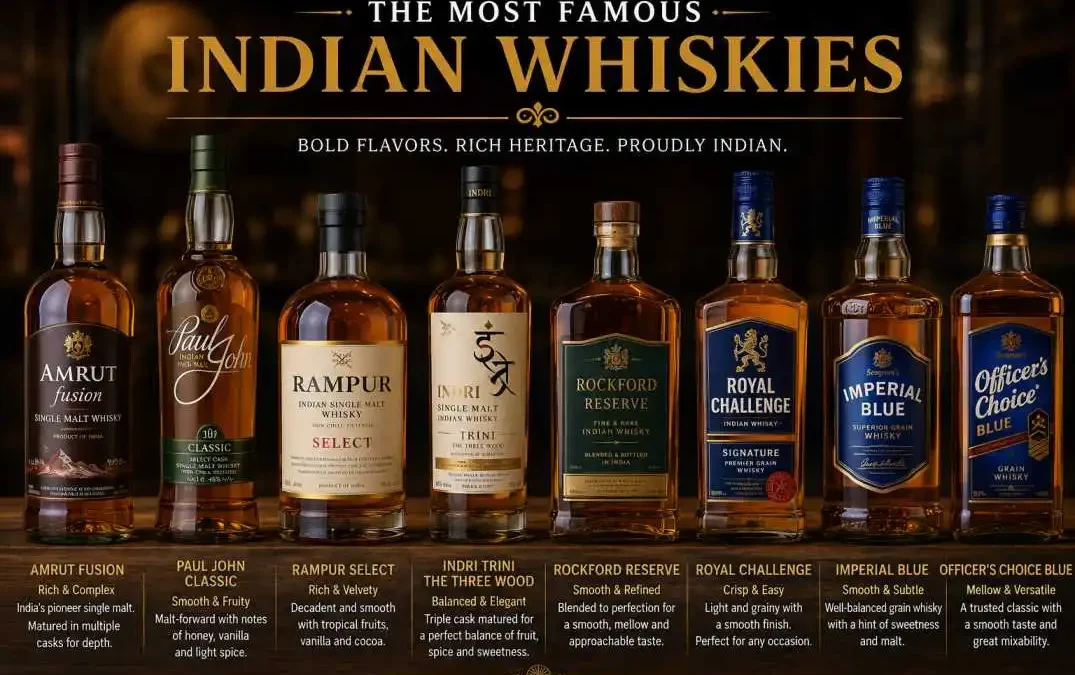
Walk into any well-stocked bar today and you’re likely to find a bottle of Indian Whisky sitting confidently next to Scotch, bourbon, and Japanese blends. That wasn’t always the case. For decades, whisky lovers outside South Asia barely acknowledged India as a serious producer. Today, that perception has flipped entirely — and if you’re just starting to explore this category, there’s a lot more nuance here than most people expect.
This guide breaks down what Indian Whisky actually is, how it’s made, and what to look for as you start building your own understanding of the category.
What Exactly Is Indian Whisky?
The term covers more ground than many newcomers assume. Historically, a large portion of what’s labeled whisky in India was actually made from molasses — a byproduct of sugarcane — rather than grain. This distinction matters because, under the strict definitions used in places like Scotland, a molasses-based spirit wouldn’t legally qualify as whisky at all.
However, the more recent wave of premium Indian Whisky has shifted the conversation entirely. A growing number of distilleries now produce grain-based single malts using barley, following production methods closely aligned with traditional Scotch whisky techniques. This shift is a major reason the category has earned serious international respect in the last two decades.
Molasses-Based vs. Grain-Based: The Core Distinction
Understanding this split is the single most useful thing a beginner can learn.
Molasses-Based Whisky
- Made from sugarcane molasses, similar in raw material to rum
- Typically more affordable and widely consumed domestically
- Often blended with a small percentage of imported Scotch for flavor complexity
Grain-Based Whisky
- Made from malted barley, following traditional single malt production methods
- Aged in oak casks, often for several years
- The category responsible for India’s rising international reputation
If you’re new to exploring this whisky, starting with a grain-based single malt will give you the clearest picture of what the category is capable of at its best.
Why India’s Climate Changes Everything
One of the most fascinating aspects of Indian whisky production has nothing to do with ingredients — it’s about geography. Much of India’s whisky is distilled and aged in regions with significantly hotter climates than Scotland’s cool, damp conditions.
The Angel’s Share Effect
- In Scotland, distillers lose roughly 2% of a cask’s volume to evaporation each year
- In parts of India, that evaporation rate can climb to 10% or more annually
- This accelerated interaction between spirit and wood means this whisky matures faster than its Scottish counterparts
Practically speaking, a whisky aged for just four or five years in India can develop a depth and complexity that might take twice as long to achieve in a colder climate. This is part of why age statements don’t carry the same weight when comparing it to Scotch — the numbers simply aren’t measuring the same maturation process.
Getting to Know the Category’s Structure
Before diving into specific bottles, it helps to understand where Indian Whisky fits within the broader world of whisky styles. Because the category blends elements of both traditional Scotch-style production and unique regional influences, newcomers sometimes struggle to place it. For anyone wanting a broader foundation before narrowing in on India specifically, this complete guide to whisky types offers a useful overview of how different whisky categories are classified and where regional styles diverge.
With that broader context in mind, Indian single malts become easier to appreciate on their own terms rather than through a purely Scotch-comparison lens.
What to Expect on the Palate
Flavor profiles vary significantly depending on production style, but there are some recognizable characteristics that show up frequently in premium Indian expressions.
Common Flavor Notes
- Rich dried fruit and honey, often more pronounced than in cooler-climate whiskies
- Warm spice notes, sometimes echoing the region’s culinary influences
- A fuller, oilier mouthfeel due to accelerated cask interaction
- Occasional smoky or peated expressions, depending on the distillery’s style
Because of the faster maturation process discussed earlier, many Indian whiskies deliver a boldness and richness that can feel unexpectedly mature for their stated age.
How to Start Tasting Indian Whisky as a Beginner
If you’re ready to explore the category for yourself, you can browse our Indian whisky selection to discover grain-based single malts and other expressions from India, with options suited to different tasting preferences and budgets.
A Practical Approach
- Start with a well-reviewed single malt in the mid-price range to establish a baseline
- Taste it neat first, then with a small amount of water to open up the aromatics
- Compare it against a Scotch single malt of similar age to notice the climate-driven differences
- Take notes on sweetness, spice, and mouthfeel to track your preferences over time
This kind of side-by-side comparison is one of the fastest ways to understand what makes this whisky distinct rather than simply “similar to Scotch.”
Common Misconceptions Worth Clearing Up
A few myths tend to follow this category, even among casual whisky drinkers.
Myth: All Indian Whisky Is Made From Molasses
This was largely true decades ago, but premium grain-based single malts have become a significant and rapidly growing part of the industry.
Myth: Indian Whisky Can’t Compete With Scotch
International blind tastings and awards over the past several years have repeatedly challenged this assumption, with Indian expressions winning recognition against long-established Scotch competitors.
Myth: Age Statements Mean the Same Thing Everywhere
As covered earlier, the accelerated maturation caused by India’s climate means direct age comparisons with Scotch can be misleading.
Where the Category Is Headed
The momentum behind Indian Whisky shows no signs of slowing. Distilleries are investing in new production facilities, experimenting with regional grain varieties, and increasingly targeting export markets that were previously dominated by Scotch and Japanese producers. For a category that was largely overlooked internationally just twenty years ago, that trajectory says a lot about where things are headed.
Final Thoughts for New Explorers
Understanding Indian Whisky isn’t about memorizing brand names — it’s about grasping the production methods, climate influences, and flavor characteristics that make the category genuinely distinct. Once those fundamentals click, exploring specific bottles becomes far more rewarding, because you’ll actually understand why a given whisky tastes the way it does rather than just whether you like it.
Whether you start with a grain-based single malt or a more traditional blended expression, approaching it with curiosity rather than comparison to Scotch will lead to a much richer appreciation of what the category has to offer.



Recent Comments